

SEO is not a one time task, It is a continuous process. SEO can increase your website traffic, generate leads, grow your business. SEO is not optional, it is essential.
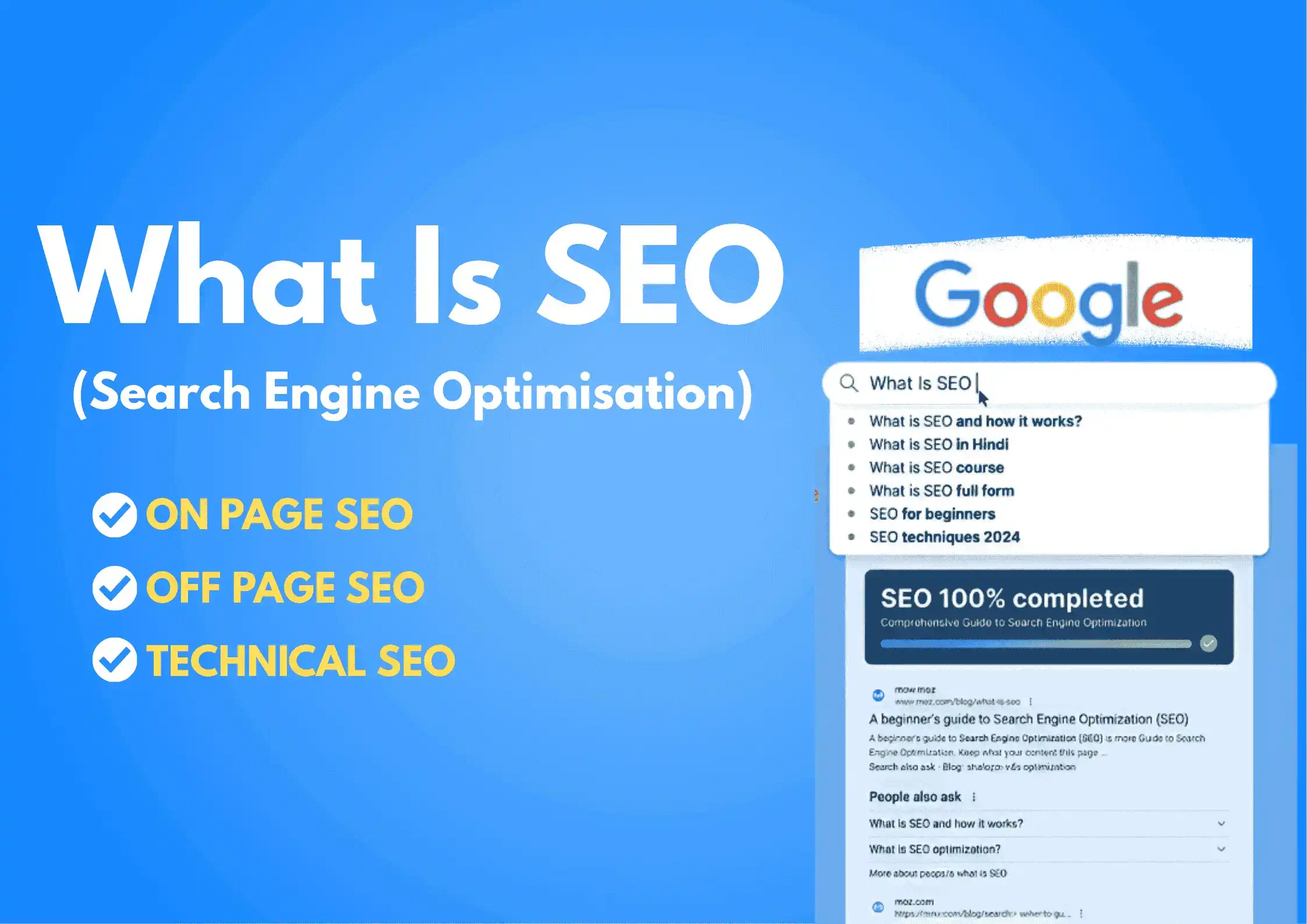
SEO (Search Engine Optimization) is the process of improving your website so it ranks higher in Google’s search results and attracts more visitors — without paying for ads. If your website exists but nobody searching on Google can find it, SEO is almost always the missing piece.
This guide explains what SEO actually is, the different types you need to know, how long it realistically takes to work, and how AI-powered search is changing the game in 2026.
SEO stands for Search Engine Optimization, the practice of optimizing a website’s content, structure, and reputation so that search engines like Google understand what it offers and rank it higher for relevant searches.
Here’s a simple way to think about it: when someone searches “best digital marketing agency in Delhi,” Google scans billions of pages and decides, in a fraction of a second, which ones deserve to appear on page one. SEO is everything you do to convince Google that your page is the most relevant, trustworthy, and useful answer to that search.
Good SEO touches four things:
The stronger these four are, the higher your ranking potential.
Paid ads stop the moment you stop paying. SEO keeps working in the background, month after month, without a per-click cost. That’s the core reason businesses invest in it:
SEO isn’t one activity it’s four connected disciplines that all need to work together.
On-page SEO covers everything you control directly on your website:
Good on-page SEO makes it obvious to both Google and a human reader exactly what a page is about within the first few seconds.
Off-page SEO is everything that happens away from your website but still affects your ranking:
Technical SEO makes sure Google can actually crawl, understand, and index your site properly. Even the best content won’t rank if Google can’t access it cleanly.
Key technical factors:
If your business serves a specific city or region like most businesses across Delhi NCR, local SEO is arguably the most important type of all, and it’s often overlooked.
Local SEO focuses on:
For a business trying to be found by customers in Noida, Gurugram, Faridabad, or Ghaziabad specifically, generic national SEO isn’t enough — you need content and signals tied to those exact locations. Explore our local SEO approach to see how this works in practice.
People often confuse the two:
Most businesses get the best results from doing both: SEM for fast, immediate leads while SEO builds toward sustainable, long-term visibility.
This is one of the most common and most important questions business owners ask, and honest answers matter more than fast promises.
Any agency promising page-one rankings in 30 days is either using risky tactics that can get your site penalized, or setting expectations that won’t hold up. Real SEO is a compounding process, not a switch you flip.
Search itself is changing. Google’s AI Overviews, along with tools like ChatGPT and Perplexity, are increasingly answering questions directly — sometimes before a user ever clicks through to a website. This has given rise to what’s often called GEO (Generative Engine Optimization) or AEO (Answer Engine Optimization): structuring your content so AI systems are more likely to cite your business as a source.
In practice, this means:
Traditional SEO and AI-search optimization aren’t separate strategies a well-optimized, genuinely useful page is well-positioned for both.
You can’t improve what you don’t measure. Two free tools should be non-negotiable for any website:
Google Analytics shows you who’s visiting, where they came from, and what they do once they arrive — visitor counts, traffic sources, behavior, and conversions.
Google Search Console shows you how Google itself sees your site — which keywords you’re ranking for, your clicks and impressions, indexing issues, and technical errors that need fixing.
Together, these two tools turn SEO from guesswork into a measurable, improvable process.
| Benefit | What It Means for Your Business |
|---|---|
| Higher rankings | Your website appears where customers are already looking |
| More organic traffic | Visitors arrive without a per-click ad cost |
| Better lead quality | People searching are already interested, not just browsing |
| Long-term cost efficiency | Cost-per-lead drops over time compared to paid ads |
| Stronger credibility | Top rankings signal trust to potential customers |
| Compounding results | Effort invested today keeps paying off months later |
SEO is the process of improving a website so it shows up higher on Google when people search for related products or services, bringing in visitors without paying for ads.
Early improvements can appear within 1–3 months, but meaningful rankings for competitive keywords typically take 6–12 months of consistent work.
Neither is universally “better” SEO builds sustainable, long-term traffic, while Google Ads delivers immediate visibility. Most businesses benefit from using both together.
On-page SEO, off-page SEO, technical SEO, and local SEO each plays a different role, and effective SEO requires all four working together.
Basic on-page fixes are doable in-house, but competitive rankings usually require ongoing technical, content, and link-building work that most business owners don’t have time to manage alongside running their business.
SEO isn’t a one-time checklist — it’s an ongoing investment that compounds over time. Done consistently, it increases your website traffic, brings in higher-quality leads, and builds long term visibility that paid ads alone can’t replicate.
If your website isn’t showing up where your customers are searching, Click Drip and see exactly what’s holding your rankings back.





Ready to speak with a marketing expert?
